Care for your whole cycle —
gentle with you on the heavy days.
A breath-led somatic yoga practice for period pain: gentle care on the heavy days, quiet daily work on the other days of the month, so the hard ones have somewhere to land.
Read the transcript
Welcome. I’m really glad you’re here. If you’re watching this, there’s a good chance you already know the heavy, invisible load of managing your body’s hormonal rhythms. I know the severe tension and brain fog that builds in the days leading up to your period, the mood swings, the heavy legs. And when your cycle finally arrives, I know the lower back pain that won’t quite let go, followed by the lingering fatigue long after it’s over.
You’ve likely been told that extreme PMS, severe cramps, or the chaotic cycles of PCOS and PCOD are just part of being a woman. But you and I know it is so much deeper than that. In fact, medical experts are now pushing to rename it PMOS — polyendocrine metabolic ovarian syndrome — because they realize what you already know: this is a full-body metabolic and nervous system load, not just a reproductive one. I’m here to validate something you’ve probably felt for a long time. Suffering through your cycle might be common, but it is not normal.
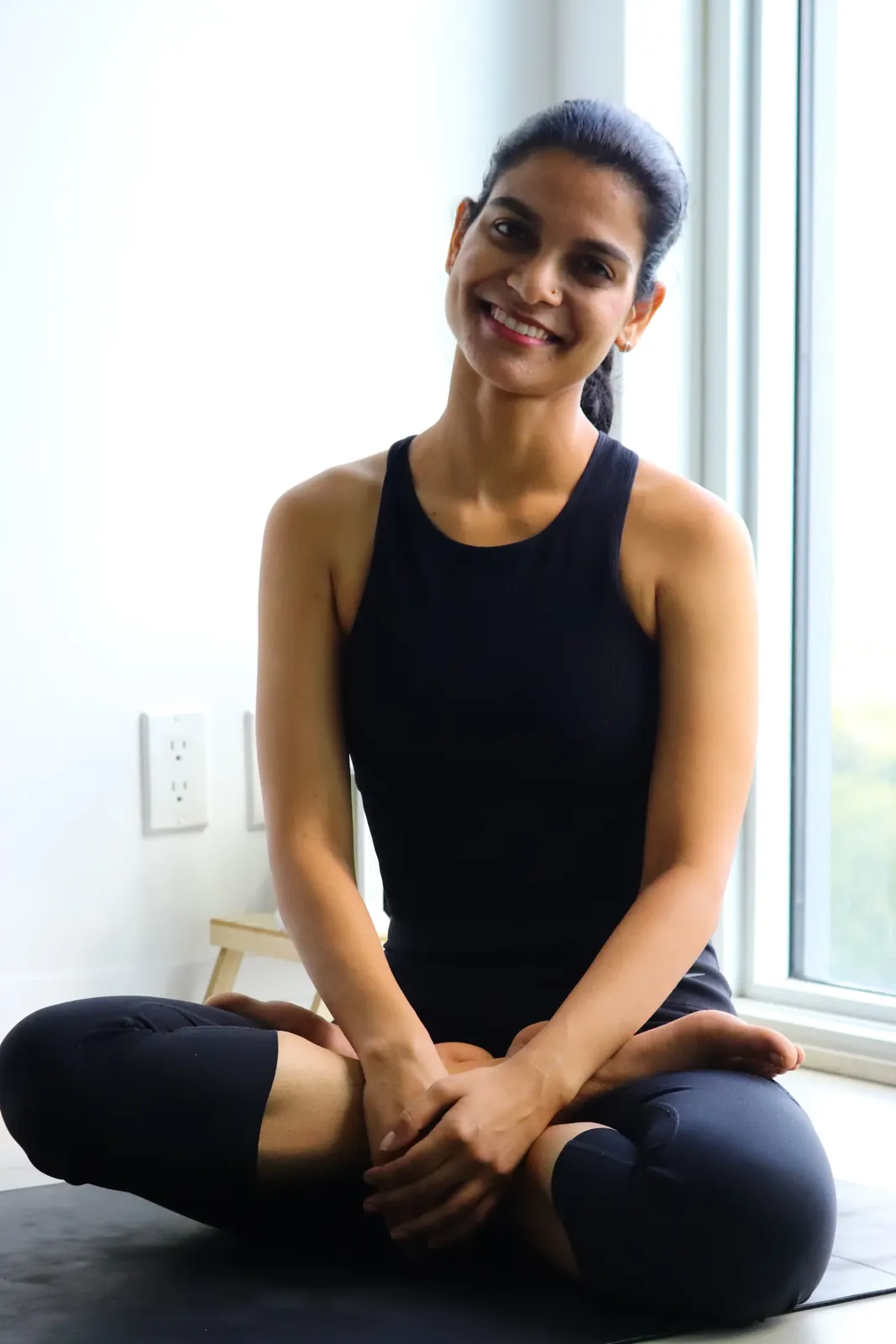
My name is Sakshi Juyal, and as a professional yoga teacher I’ve had the honour of guiding more than 5,000 individuals globally, blending the rich, ancient wisdom of yoga with the modern science of nervous system regulation.
I want to be completely transparent with you. Yoga is not a magic painkiller. If you are in the middle of immense, blinding, acute pain, you do not need to force your body into a posture. In those moments, your body simply needs pure rest or medical care. But for the heavy days leading up to your period, the manageable discomforts during your bleed, and the exhaustion afterwards, true, deeply restorative yoga is your greatest toolkit.
The modern wellness world has turned yoga into just another intense workout to conquer. We force ourselves through grueling routines on our most tender days because we feel guilty for resting. But true yoga was never meant to be a performance. It is a practice of returning home to your body.
When you live with a constant mental load, your nervous system stays stuck in fight or flight. And when your body is in survival mode, it biologically deprioritizes reproductive health; it shuts down your natural rhythmic flow. You cannot support a hormonal imbalance while running on adrenaline. Your body doesn’t need more pressure. It needs a signal that it is safe. This is why randomly searching for stretching videos online often leaves you feeling more exhausted. Random movement does not regulate a stressed nervous system. We need to stop using movement to punish our bodies and start using purposeful yoga to support them. We need to stop working out, and start working in.
This is exactly why I created the Soft Cycle Protocol: Rest, Relief and Gentle Care. This is an evidence-informed, trauma-aware approach to yoga, designed specifically to support your entire rhythm — before, during, and after you bleed. Inside, you’ll find a responsive, prop-friendly toolkit. You get eight guided fifteen-to-twenty-minute restorative yoga flows designed for specific sensations — whether you need lower back pain relief, ease for the feeling of bloating, or a way to lift brain fog. You will learn pranayama — ancient yogic breathwork tools that manually switch your nervous system back to safety before a flare-up peaks. And on the days when your energy is at zero, you will use guided Yoga Nidra practices, the powerful yogic science of conscious deep rest that supports a healthy stress response without you having to move a single muscle. You will also receive a downloadable somatic journal and practice calendar to track your body’s unique rhythms, so you can anticipate your needs before they happen. I want this to be accessible to you whenever you need it most, right in your home.
Right beneath this video, you will see a few ways we can begin. You can choose the Essential Care path for complete access to the Soft Cycle Protocol. However, because your hormonal rhythms and your daily stress are so deeply connected, the path I highly recommend — and the one most women choose — is the Regulation Bundle. This pairs your cycle care with my foundational Nervous System Regulation program at a special bundle rate, giving you a complete yogic life-management system for lasting harmony all month long. And for the women who want me to walk this path beside them personally, there is the Personal Guidance Track, which includes a 90-minute deep attunement — which helps me help you — and three one-on-one follow-ups to design a custom protocol just for you.
Because this entire space is built on safety, I want your decision today to be completely free of stress. I am so confident in this protocol that it comes with a 14-day somatic guarantee. No pressure, no hard feelings. I only want this in your hands if it truly supports you. You don’t have to just survive your cycles anymore. You can actually soften into it. Explore the offerings below and choose the path that feels right for your body today. You will also get access to a private Yogneeti Community Circle, so you never have to walk this path alone.
Place one hand on your belly and the other on your heart. Take a gentle inhale, and a longer exhale. Nothing to prove, everything to receive. I can’t wait to see you on the mat.
Four cycle phases · from your bed · 14‑day guarantee
Experience the shift for yourself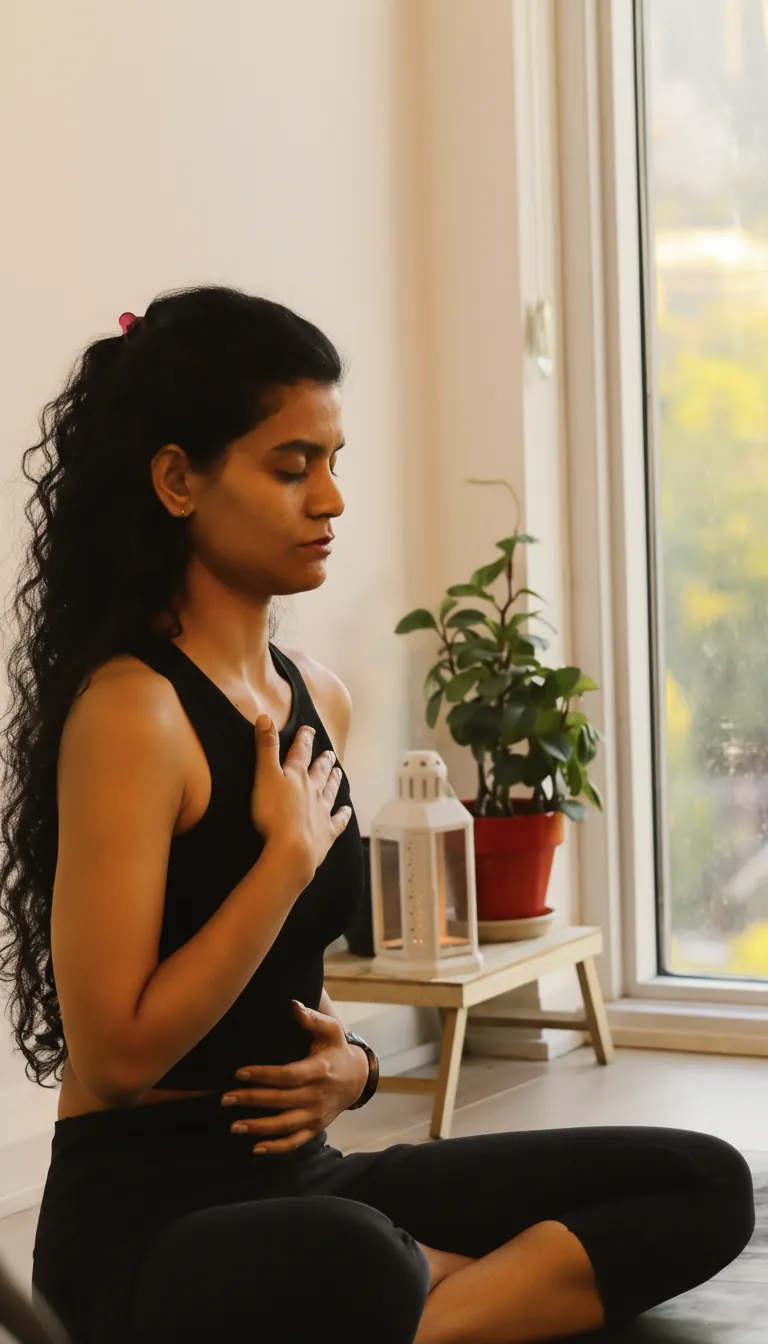
You are likely
here because…
Your exhaustion has become your baseline, and every month feels like starting over.
You are carrying the heavy, invisible load of managing your body’s hormonal rhythms.
The bloating, the brain fog, and the emotional shifts sit painfully close to the surface.
You are tired of pushing through pain to maintain a routine that was never designed for your cycle.
You want relief that is gentle, and that lets your body believe it is finally safe to rest.
None of this means your body is failing you. It means she has been asked to keep a pace that was never hers — and pain is how she says so.
Experience 3 minutes of the program right now.
Find a comfortable, quiet seat. Turn the sound on, close your eyes, and follow along. This is the actual first practice from the program — the 3-Part Breath and a slow Cat-Cow — so your nervous system can feel what structured somatic care is like.
Read the transcript
We’ll start by coming into a comfortable sitting position. If it suits you, you can sit in a cross-legged position or on a chair. Allow your spine to be straight and shoulders relaxed. Slowly place your right palm on your chest and left palm on your belly, keeping your elbows relaxed and facial muscles relaxed. Just let your breath come in and out, observing each inhale, each exhale — noticing the subtle expansion of your belly and of your chest with each inhale, and notice how your belly and chest go back with each exhale. Allowing your body balance to be centered, feeling it in your sitting bones. Each breath brings you more and more into this present moment. Each breath allows you to connect with yourself, letting your senses turn inwards.
Slowly release your palms back onto your knees, letting your breath take its normal course. With the next inhale, reach up with your chin; exhale and come back down again. Inhale, reaching up; exhale, down. Breathing in, reach up; exhale and come down, and gently come back centre. Taking the head towards the left side first, and slowly, with your left palm, gently pull your head towards the left shoulder. Release the arm, and let’s go towards the right side now. And now with the right arm, gently pull your head towards the right shoulder. Slowly release the arm and come back centre with the neck.
Now proceeding towards the shoulders. We’ll start working with the shoulders, rotating them front to back. As you breathe in, reach up with the shoulders towards your ears, roll them back, working with the shoulder blades as much as you can, and slowly come back centre. Reach back with your arms, interlace your fingertips, expanding the chest, reaching up with the chin, releasing the tension, the stress from your neck, from your upper back — observing the gentle compression in between your shoulder blades. Keep breathing into your chest and feel this gentle release from your back. Breathing in, breathing out. Come back centre, slowly release your arms, and take a nice deep breath, observing the effects of this stretch with your chest, with your arms, with your shoulders.
Next, we’ll bring our left leg over the right knee. For support, you can place a cushion or a pillow under your left knee, and slowly, as you exhale, walk forward with your arms so as to stretch your spine in front, releasing your spine, especially your lower back. Allow your head to go closest to the floor, relaxing your neck and your shoulders. Breathing in and breathing out. Keep your arms stretched so that you can release the tension from your shoulders as well, keeping your hip grounded; let your lower back feel the release as well. Inhale and come back centre. And now softly change your legs: let your right foot come over the left knee, and once again, as you exhale, walk forward with your palms, with your fingertips, and let your spine extend in front. Here as well, if you require, you can take the support of a cushion or a pillow under your right knee. Allow your spine to feel the release; allow your shoulders and your neck to feel the release. Slowly come back centre.
And now we’ll switch into the butterfly pose. We’ll get our feet together, joining the soles of our feet, letting our knees go down towards the floor as much as we can, interlacing the fingertips and holding on to our feet, keeping the spine straight, shoulders rolled back, making sure that the weight of the body stays on the sitting bones. You can choose to close your eyes here and just be in this posture for a breath or two. Breathing in and breathing out. And as you hold this posture, visualize the release, the relaxation within your pelvic joint, your pelvic bowl — breathing into your pelvic organs, your uterus, your womb, and let it ease out any kind of stress, any tension that your pelvic organs, your pelvic muscles might be holding on to. Taking a few more conscious inhales and conscious exhales. With each exhale you’re trying to release your knees further down towards the floor, letting your pelvic joint open up further. For butterfly pose, if you need support, you can place a couple of blocks or cushions under your knees to support you; it will help you sit in this posture for a little longer.
And slowly, let’s switch our position. We’ll get the knees in and extend our legs out, keeping our feet together, spine straight, knees pushed down. Let’s lift our arms up with an inhale, reaching up with the arms, keeping the spine straight. With the next exhale, you let your arms go forward and down towards your feet, hooking your big toes with the first two fingers. Allow your body to come into this forward fold position. You can also do this posture by placing a cushion under your knees to give you a little more comfort. You can also place a cushion or a pillow in between your thighs and your belly. This is a nice way to let your spine and your upper body altogether feel the release and rest that you require during this time. You can adjust the placement of the cushion under your thighs and the belly to suit you the best. With each exhale, allow your upper body to feel the release. You can also try placing both the cushions under your knees. The objective is to let the upper body feel the release, and find a gentle stretch in your glutes, in your hamstrings. In this forward fold position, the muscles of the belly, of the pelvis, try to get stimulated.
No specialized yoga blocks or props required. Wear whatever you are currently sitting in. This is about internal safety, not physical performance.
If that felt like something your body wants more of, the full pathway is just below. If it didn’t, that is useful to know too.
Structured care, not a random playlist.
Five kinds of support, arranged into four gentle phases — built around how you feel, not a rigid calendar.
-
8 Cyclical Somatic Flows
Restorative sequences mapped to the four seasons of your cycle.
-
Gentle Movement for Aching Days
Slow, supported spinal work you can do from your bed.
-
The Pranayama Vault
Classical breath tools, including Anulom Vilom and Bhramari.
-
Guided Yoga Nidra
Conscious deep rest, without moving a single muscle.
-
Somatic Compass
Downloadable journals and calendars to track your own rhythms.
What actually causes menstrual cramping, and how prostaglandins work. What PCOS and PCOD are, in plain language. Your detailed course walkthrough, so you always know what’s ahead.
Butterfly pose, seated forward folds, reclined twists, and pelvic floor work. Every pose has a prop modification. Start here on your heaviest days.
Cat-cow, downward dog, child’s pose, garland pose, forward folds. Deeper flows for days when you have a little more energy but still want gentleness.
Hip openers, bridge pose, half plow, thread the needle, supine twists. Floor-based flows with blanket and block support for complete release.
Diaphragmatic breathing to help ease cramping. Anulom Vilom (alternate nostril breathing), traditionally used to support the body’s rest-and-digest response. Bhramari (humming bee breath) for deep calm and comfort during cramping.
An evening wind-down meditation with body scan and golden light visualization. Plus a complete Yoga Nidra with sankalpa, body rotation, and guided imagery — for days when rest is what your body is asking for.
Start with how you feel today — let your body guide your path.
“This is not about perfection. It’s about returning to a body that finally feels safe.”
I grew up inside this tradition — yogic philosophy, breath, and Ayurveda were the texture of ordinary days, not a discipline I took up. Seven years of full-time teaching later, I bring those ancient teachings together with a contemporary understanding of how the female body holds and releases stress.
I built this program for the days when your energy pulls inward — so that caring for yourself never costs more than it gives.
This course was built for the women who…
- Want gentle ways to ease menstrual pain without pushing through it
- Need to ground their nervous system on tender days
- Want a practice that holds them in the sensitive days before their bleed, not only during it — when the body asks for warmth, slowness and a softer pace, so it can prepare for a more grounded, gentle transition
- Want movement that respects their cycle, not ignores it
- Have been looking for a practice designed for women’s bodies
- Simply need permission to rest and be held
We share this because we genuinely want you to find what serves you best — and that kind of honesty is part of how we care.
Common Questions
Yes. You pay once and keep lifetime access to all course materials. No recurring fees, no surprise renewals. The Monthly Community Circle is included for everyone.
The 14-Day Alignment Guarantee
If the practice isn’t right for you, write to care@yogneeti.com within 14 days of your purchase and we’ll refund you in full, as long as you’ve viewed 15% or less of the curriculum. One purchase, lifetime access, and no renewals — ever.
Absolutely — this course was designed specifically for those days. Every sequence is gentle, restorative, and built to ease discomfort rather than add to it. Listen to your body and rest whenever you need to.
A yoga mat, a pillow or cushion, and optionally a blanket and blocks. Sakshi shows modifications using household items — you don’t need specialized equipment.
Many women with PCOS or PCOD find the pace supportive — the flows are gentle, prop-supported, and never ask for intensity or a predictable cycle. Because PCOS and PCOD show up differently for everyone, check with your doctor before starting, and let this sit alongside your medical care, never in place of it.
There is no schedule to fall behind on. The course is entirely self-paced with lifetime access. Missing a day is not failure — it is listening to your body. Come back whenever you’re ready.
Every single pose has a supported modification. Many flows are done lying down or seated. This is not about strength — it’s about care. You don’t need to build anything before you begin.
No. This course provides general wellness education and guided yoga, not medical advice. If your pain is severe, worsening, or unresponsive to supportive care, please consult a clinician. Stop any pose that causes pain or dizziness.
Free content is designed for general audiences. This program is a structured sequence built specifically around the menstrual cycle — each flow is phase-appropriate, props are always guided, and the eight sessions build on one another. You also get the community, the journal, and Sakshi’s direct support.
Yes. The course platform works on all modern devices — phone, tablet, and desktop. Many students practice from bed or a mat with their phone propped nearby.
This course is general wellness education, not medical advice. Stop if anything causes pain. Consult a clinician for severe or worsening symptoms.
Also here
If this isn’t your door, there is another one.
Some women arrive needing the structure of a program. Others need somewhere to return to on an ordinary Tuesday, with no pathway to keep. The Practice Library is the second kind of place — a living collection of sessions, sorted by time, by mood, and by what your body can hold today.
Explore the Practice Library$49 per month. The first seven days are free — nothing is charged until day eight. One click ends it, whenever you like.